The Eastern Provinces
Overview
The Eastern Provinces were a collection of Isutan kingdoms that joined together to create a united federation governed by the Ganpoumi Fi. Later on, the Songkram Empire would become the major power governing the Eastern Provinces, and did major pushes to eliminate what little boundaries remained between them.
The Eastern Provinces were a conglomerate of independent states governed by the Ganpoumi Fi federation prior to its collapse in 268 DHT. In Legerian history before the Demon Wars, each province was its own small, localized kingdom, aptly called the Eastern Kingdoms. The constant feuding between these kingdoms over the bountiful Sangmyung resulted in constant bloodshed and a lack of global geopolitical power--something that the Eastern Kingdoms needed to confront especially with the growing might of Corgath North of them. The kingdoms united under the banner of the Ganpoumi Fi, which would lead them into becoming the far more powerful unified Eastern Provinces.
There were 7 provinces total: Zhing, Mah Mur, Yedom, Maena, Niman, Gūm Ma, and Du Dô.
| Province | Capital City |
|---|---|
| Du Dô | Hubei |
| Gūm Ma | Fi Lo Hok |
| Maena | Ailang |
| Mah Mur | Gong |
| Niman | Jingho |
| Yedom | Fuga |
| Zhing | Zokino |
History #
The Eastern Provinces (formerly Eastern Kingdoms) were at war with each other for many years, embroiling the Sangmyung Valley in thousands of years of war. During the Mundane War, the seemingly unstoppable rampage of Sandar across Legere moved Du Dô, Maena, and Gūm Ma to come to the aid of Nungul. As the nations cooperated through espionage against Sandar, they would eventually form a union that persisted even after Sandar's defeat. For the next hundred years, this federation would seek to unite the Sangmyung Valley.
Once unified, the provinces had their leader, known as a councilor, serve as a representative in the courts of the Ganpoumi Fi. Councilors were not elected democratically, but were instead still inherited positions. In doing do, the Ganpoumi Fi were able to satisfy the desire of each province's noble or royal families to continue on their lineages.
The Songkram would make sweeping changes to the governance of the Eastern Provinces by deposing councilors loyal to the Ganpoumi Fi and instating new puppet leaders (known as grandmasters).
Provinces #
Each of the provinces that comprise the Eastern Provinces were once independent, sovereign nations referred to as the Eastern Kingdoms.
Du Dô #
As a central province, Du Dô was filled with rich merchants and tradesmen. It found itself becoming the trade capital of the Eastern Provinces. Even during the wars of the Eastern Kingdoms, Du Dô was a powerful nation that leveraged their economic fortitude against those who waged war against it.
Du Dô's capital was the city of Hubei, which would eventually become the capital city of the Eastern Provinces while the Ganpoumi Fi were in power.
Gūm Ma #
Gūm Ma was the smallest of all the provinces, but retained economic relevance by providing the whole of Sangmyung Valley with rare and expensive herbs, spices, fungi, and roots. As the globalization of Legere increased, Gūm Ma's prosperity only grew as export of such goods to foreign nations increased.
Normally a province as small as Gūm Ma would be easy pickings for larger nations during the early days of the Eastern Kingdoms. However, the dense forests throughout the province helped the guerilla fighters that defended it to easily foil any attempt made to conquer it.
Gūm Ma's capital city was Fi Lo Hok.
Maena #
The province of Maena was the west-most province. In Isutan, Maena's name translates roughly to "The Rich Gate", referring to its role as a connection between the Eastern Provinces and the western portions of Hohm.
Maena's capital was Ailang, which was destroyed after the Eastern Civil War. Much of the Ailang's surroundings were razed to the ground as a part of this attack by the Songkram Empire, effectively leaving the entirety of the province of Maena a husk, much to the chagrin of its grandmaster.
Mah Mur #
Mah Mur was the coastal province of the Eastern Provinces, lining most of the edge of Hohm's eastern coast. It was a prosperous land that fed itself with the fruits of both land and sea.
Mah Mur was the homeland of the Songkram's first Grand Lord, Koh, and its capital city of Gong would go on to become the capital of the Eastern Provinces following the Eastern Civil War.
Niman #
Niman wasn't a very splendid-looking province in terms of architecture and cityscapes, but it was still highly important because of its fertile land. Niman made great fortune by selling rice and livestock to neighboring areas--particularly, the province of Du Dô.
Niman's capital city was Jingho.
Yedom #
Yedom was situated at the lowest point of the Sangmyung Valley and was best known for its awe-inspiring capital city of Fuga, which sat in the Slingwhip-fed Mong's Bore.
Zhing #
Zhing was the northernmost Eastern Province, and served as a buffer between Corgathian territory and the rest of the provinces. Zhing was widely a poor province, with all of its business and trade localized within a single point--its capital city of Zokino.
Zhing was the sole Isutan province that experienced wintery conditions during storm years.
Language #
![[Isutan]]
Currency #
Most of the Eastern Kingdoms had their own, antiquated monetary systems, but under the unification of the Ganpoumi Fi, the Provinces began to use the centralized dal system.
Dal & Kiyu #
Dal were silvery coins possessing a hole through their center that allowed them to slide onto a "peg" fastened to the owner's waist. A dal coin was approximately 6 centimeters in diameter, with a 1 centimeter wide hole in its center. There were also kiyu, a slightly thicker coin with bronze decal, each worth 16 dal. Like their smaller dal counterparts, kiyu also possessed a square 1-cm hole in the center. A single kiyu was roughly a day's wages.
While the Ganpoumi Fi used square coins, the Songkram Empire changed the shape of dal and kiyu to round-edged triangles. During the first couple years of the Songkram's reign, Ganpoumi Fi dal were offered to be exchanged for the new Songkram dal. However, since that time, square shaped Ganpoumi Fi dal were been outlawed as a part of the Songkram's program to erase the former government from history.
Ku #
Instead of coin purses that one might find in other places across Legere, residents of the Eastern Provinces wore a metal peg in order to store their coin. These pegs are referred to as ku and came in varying sizes depending on the individual.
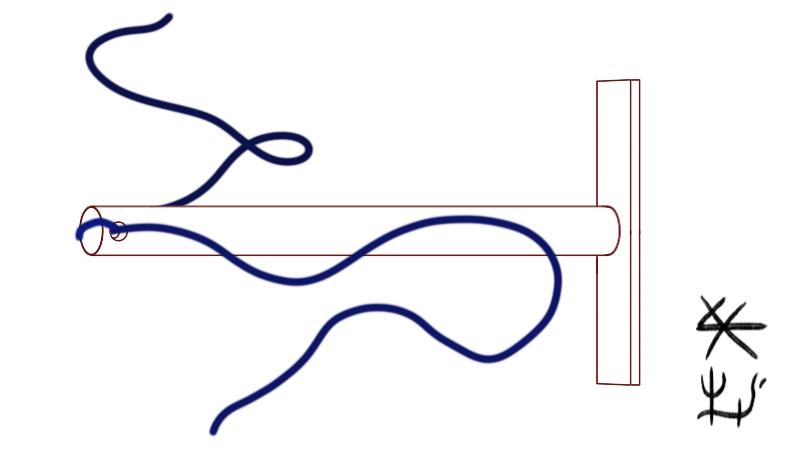
Above: An example of a very simple, undecorated ku. This piece has a cheap blue cord and a classic T crossbar.
A ku consisted of three main parts. The first was the center, which was a round metal bar just under 1 cm in diameter. As suspected, this was the part of the ku that dal and kiyu sat on. The ku's bar could be decorated with fancy engravings for those who could afford it, although most ku for peasants were either dull metal or cheap wood. At one end of the ku's bar was a "crossbar" or some other construction that prevented the coins from sliding off. This could vary in shape, size and design, although in the cheapest ku it was usually a simple T bar. On the other end of the ku was a hole large enough for a string or other kind of cord to pass through. This cord is threaded through the hole and tied in a way that leaves two loose ends. This is the part of the ku that allowed it to be tied to the owner's belt or other things. Like the other aspects of the ku, the cord was customizable: some nobles would use a silk ribbon while others would have used a chain instead of a rope. Commoners would usually just use a simple string.
The length of one's ku was an icon of social status, and was a common way to judge a person. A longer ku suggested that the individual was used to carrying more dal and was therefore a rich person. Some particularly wealthy people would abandon the use of a traditional ku altogether and instead choose to use a ku-staff. Ku-staves were walking sticks where the shaft acted as the central bar of the ku. These coin-laden status symbols make a rattling sounds as the person walked, drawing the attention and admiration of everyone around.
Warfare #
In the Eastern Provinces, warfare was waged by a class of elite warriors known as Nakai. Nakai were supported by khatkir intelligence officers, dabhai combat blacksmiths, and mabosa hedge mages.